
Can we talk for a moment about an uncomfortable truth?
The behaviours that made you successful earlier in your career are often the very behaviours that prevent you from succeeding at the next level. To succeed in a senior team, you have to replace habits that delivered individual success with behaviours that enable others to succeed.
And there’s a pattern showing up right now across growth-stage companies: leadership confidence is falling, not rising, even as businesses scale.
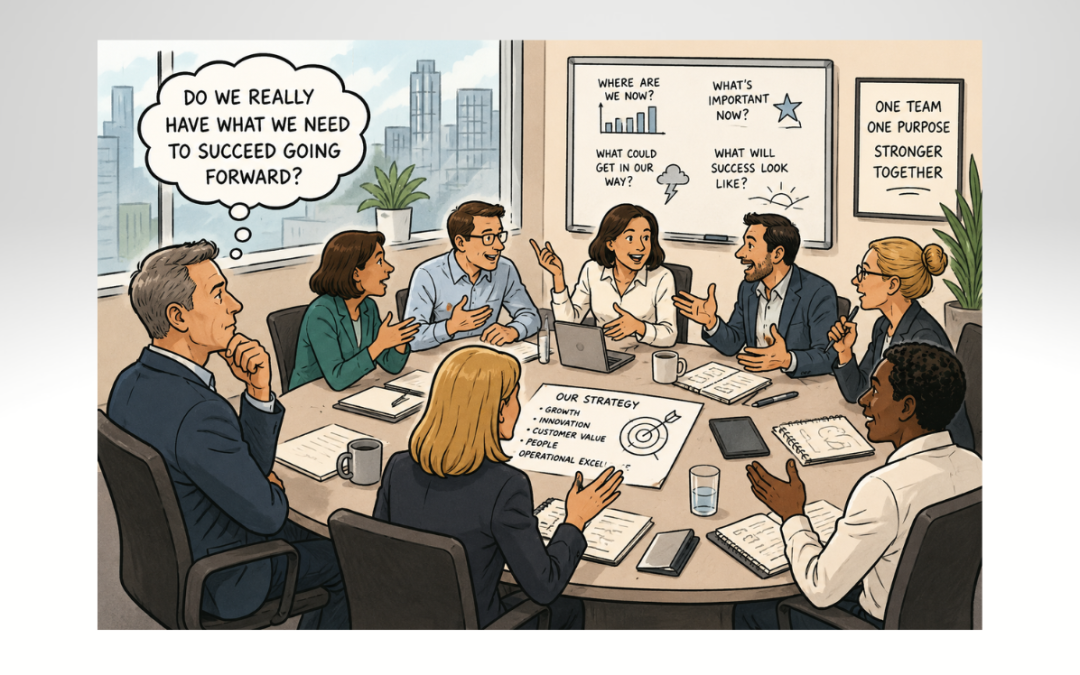
And two questions that are emerging are whether the senior team around you is actually the right one or operating at the right level for where the business is going, and whether that team spends any real time building the layer beneath it.
Most senior team leaders assume the answer to both questions is positive, but Russell Reynolds’ most recent confidence index shows employees trust their own top teams less than they used to.
Spencer Stuart’s research into private-equity-backed software firms also found that more than half had at least one CEO change during the hold period, often within the first year, right when stability mattered most.
This probably isn’t a talent shortage story; more of a senior team composition story, and a ‘how they allocate their time’ story. The senior team that got you here is not automatically the senior team that gets you further, and even a strong senior team can slowly stop investing in what comes next.
The thing is that every senior team was assembled for one version of the business and may not be right for the next chapter.
The commercial lead who was brilliant at winning the first fifty clients isn’t automatically effective at scaling a sales function across three regions. The ops director who held everything together through the chaotic early years may not be operating in a way to run a business twice this size with proper governance underneath it.
The honest question isn’t “is my senior team good.” It’s “is my senior team right, for the next stage, not the last one.”
That means looking hard at whether you have the right team operating style and it also means being honest about misfit hires at the top table. A senior person who was right for stage one and is now becoming the constraint to growth is a much harder conversation than a middle manager who isn’t performing; and it gets avoided for exactly that reason.
Then look at where the senior team’s time actually goes.
This is the part most senior team leaders haven’t measured. Ask your senior team, honestly, how much of their week goes on running today versus building the layer below them. Most will say developing their people is a priority. Trouble is, very few can point to calendar time that proves it.
McKinsey’s work on middle managers makes the commercial case bluntly: manager quality tracks closely with shareholder returns, and the manager layer is consistently the most overloaded, least developed layer in the business.
But that layer doesn’t develop itself. It develops because someone above them is deliberately spending time on it: reviewing decisions with them rather than making decisions for them, giving them real accountability rather than reversible task lists, and being honest with them about where they’re ready and where they aren’t.
If your senior team’s diaries are full of operational firefighting and short on time actually invested in the next layer down, you don’t have a development gap. You have a senior team that has decided, through where it spends its hours, that building bench strength is someone else’s job. Usually it ends up being nobody’s job.
Growth exposes both of these problems faster than almost anything else. A rapid scale-up, a buyout, a regional expansion, a major shift in technology or AI integration: all of these need the right kind of leadership in the senior seats and a next layer that’s been genuinely developed, not just present.
When either is missing, the next crunch point produces a people problem that gets treated as a strategy problem, which wastes another six months finding that out.
The companies getting this right treat both halves as deliberate design choices. Klaviyo, a US based marketing automation company, brought in a co-CEO specifically to split the load between product vision and go-to-market execution before the strain showed up in the numbers. Revolut, a digital bank, strengthened its board with people who’d already navigated regulated, high-scrutiny environments, ahead of the moment it needed that experience most.
Neither move was reactive. Both were decisions about the kind of leadership needed at the top table, made early, by senior teams that treated this as a strategic imperative and something you get ahead of rather than something you fix under pressure.
If you are leading a growing company, here is what I would recommend.
Audit your senior team against where the business is going, not where it’s been. Be specific about which roles are missing and which people, however loyal and capable, are now the constraint rather than the accelerators.
Measure how your senior team’s time actually splits between running the business and developing the one below them. Most leaders are surprised by the answer, and surprised is the point: you can’t fix an allocation you’ve never looked at honestly.
Make developing the next layer an explicit, named part of every senior role, with time protected for it, not an aspiration that gets sacrificed the moment the quarter gets busy.
Treat both of these as senior team conversations, not HR processes. The composition of your senior team and the time it spends on succession aren’t soft metrics. They’re leading indicators of whether the strategy actually gets delivered, or whether it keeps depending on the same small group of people to drive it forward.
The question isn’t whether you have good people around the table. It’s whether what got your team to this stage of growth will be what enables it to lead the next stage successfully.