
I’ve been thinking about what actually enables a senior team to perform at a higher level. It’s a question most team leaders find themselves pondering at some point, usually after reflecting that there’s more in the team tank that that is not being tapped into. How do I get more out of this team? What would it take to make them genuinely excel, rather than just function?
The thing I’ve noticed over the years is the natural default. When a leader starts pondering that question, they tend to reach for more direction and greater clarity of expectations. Tighten the strategy, restate the roles, spell out what good looks like in more detail than before. That’s understandable, and it’s usually where my conversations with senior leaders start. But in my experience it only ever gets you partway to higher, more effective performance as a team. As I’ve said (probably a billion times) before, the three factors a senior team actually needs in order to perform at that higher level to achieve the next growth milestone is clarity, unity and agility.
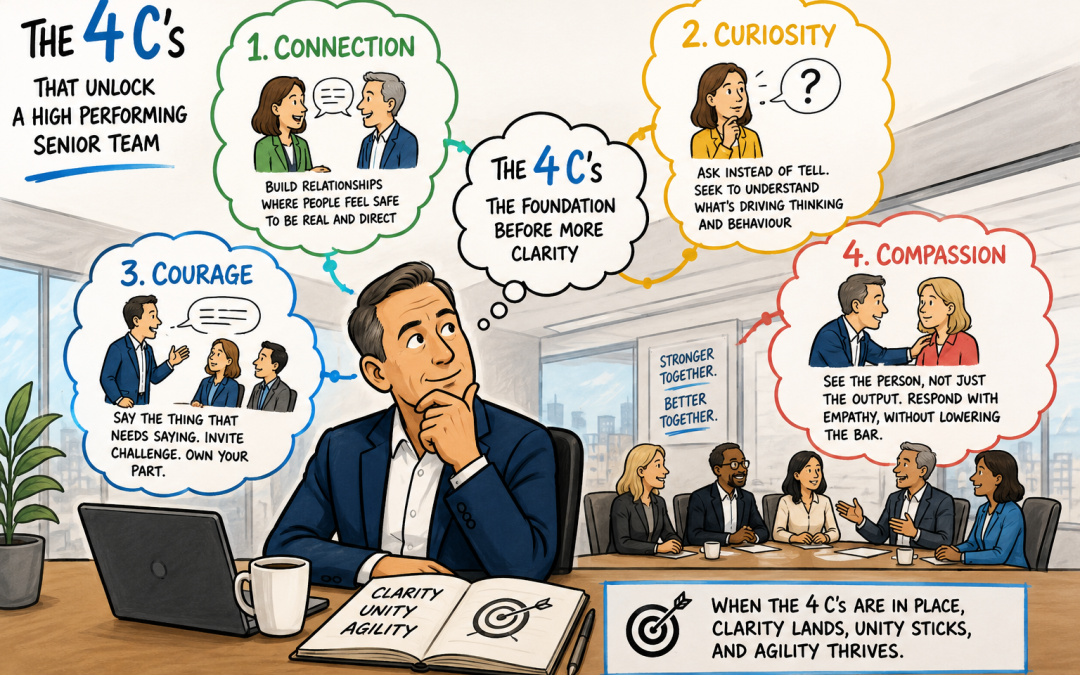
But how does a team leader actually kick start this? So, in answer to this question, I’ve borrowed something from a different world entirely: coaching. Coaches have long worked with a set of guiding principles for how to be with another person in a way that actually changes things. Translate them into how you lead a senior team and you get four qualities: connection, curiosity, courage and compassion. Not a neat acronym for a slide, but a sort of Venn diagram that opens the door clarity alone can’t. Get the first one right and the other three follow more naturally. Skip it, and clarity has nothing solid to land on.
Go with Connection first
Connection is the leader’s active creation of high-quality working relationships marked by accessibility, openness, mutual respect, individualised understanding, and reciprocal communication. It’s the quality of the working relationships in your team, not the friendliness of the Christmas party. It’s whether people feel they can be direct with each other without the relationship taking a hit. Research on team performance, including Google’s well known Aristotle Project, an internal study into what made its best teams work, keeps landing on the same finding. The strongest teams aren’t the ones with the cleverest people or the most rigid processes. They’re the ones where people feel safe enough to say what they actually think.
You’ll recognise the absence of connection more easily than its presence. It shows up as the objection that gets raised by colleagues at lunch, not in the meeting itself. It shows up when your finance director and your ops director have a good working relationship on paper but haven’t had a non-work conversation in months. Building connection might be as unglamorous as making time, in senior team meeting, for people to say what’s actually going on for them before you move to the agenda. It sounds small, but it changes what the rest of the meeting can achieve.
Curiosity
Curiosity is your willingness, as the leader, to ask instead of tell. It’s genuinely wanting to understand what’s driving a colleague’s resistance rather than working out how to overcome it. It’s the willingness to enquire about the thinking behind the thinking. Most senior leaders got to their role by having good answers. Curiosity asks you to sit in the discomfort of not having one, at least for a while.
Picture a leadership team debating a decision where two directors keep disagreeing and the conversation is going in circles. The clarity instinct says: make the call, move on. The curious instinct asks: I wonder what each of you think the other one is missing? That single question often surfaces the root idea or assumption, which is rarely about the decision itself. It’s usually about what each person believes will happen if it goes wrong. Curiosity gets you there. Clarity alone just repeats the argument more assertively.
Courage
Courage is the willingness to say the thing that needs saying, especially when it’s uncomfortable and especially when it involves naming your own part in a problem. It’s also the willingness to let others do the same, which is harder than it sounds. Plenty of senior leaders say they want challenge and then flinch, however briefly, the moment they get it.
Think of the leader who notices that every senior team discussion about underperformance somehow avoids naming who’s actually underperforming. Courage is naming it plainly, in the room, rather than letting it circle as a vague reference to “some areas of the business”. It also means admitting when your own decision created the confusion you’re now trying to clear up. That admission, done well, tends to earn more respect than it costs.
Compassion
Compassion is noticing when a colleague is under real strain and responding to the person, not just the output. It’s easy to mistake this for softness, and easy to worry that compassion and high standards can’t coexist. They can. Compassion doesn’t mean lowering the bar. It means understanding what’s making the bar hard to reach right now, and responding to that honestly.
A senior leader who notices their operations director has become sharper and less patient in meetings has a choice. Push through the agenda and note the change as a performance issue, or ask directly what’s going on for them. The second approach costs five minutes. It often reveals something that no amount of clearer KPIs would have surfaced, and it tends to get better performance out the other end, not less.
Navigating the Venn diagram
These four qualities aren’t independent options. They overlap with each other, but I suggest connection has to come first because it’s what makes the other three possible. Curiosity without connection feels like interrogation. Courage without connection feels like an attack. Compassion without connection looks performative. Get connection right and the rest becomes available to you in a way it just isn’t otherwise.
Of course, none of this replaces clarity of direction. Clear roles, clear standards and clear expectations still matter, and a team without them will struggle regardless of how connected they feel. But if you’ve already tried the advocacy approach and restated strategy and expectations as a means of gaining team clarity, and the team still isn’t firing the way you know it could, the answer probably isn’t more clarity. It’s further back than that.
The senior teams that perform at a genuinely higher level aren’t the ones with the most polished plan. They’re the ones where people trust each other enough to disagree honestly, ask honest questions, say hard things and notice when someone is struggling. Clarity tells your team what to do. Connection, curiosity, courage and compassion determine whether they’ll actually do it well, together.
Where does your senior team stand on these four, right now?