
Give a senior team three or four successful years together and it develops a kind of fluency. People know who knows what. Decisions get made faster because less has to be spelled out each time. Trust is high, and it has been earned the hard way. Fluency in the team is real, and it’s probably one of the most valuable assets a business can own.
It is also the thing most likely to catch the team out when the work changes.
A team that has won together builds what researchers call shared cognition: a shared map of how each member thinks and where the expertise sits. It builds collective confidence and it builds speed. Their three assets, clarity, unity and agility, are exactly what carried the team through their previous chapter, whether that was transformation, recovery, or a hard push for growth.
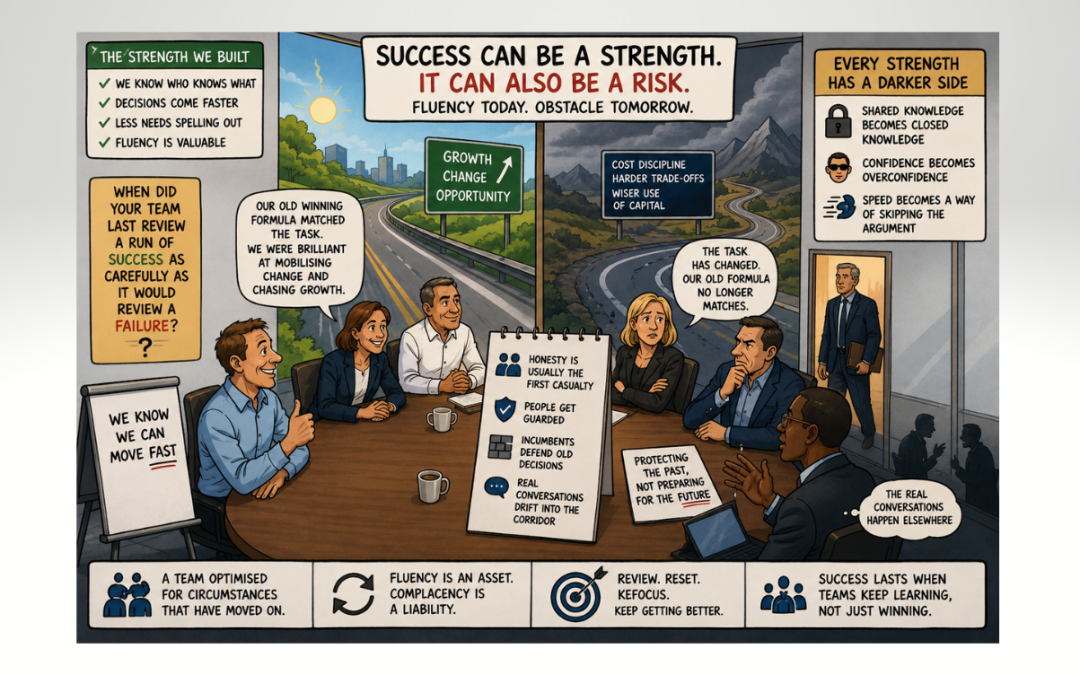
But the team can also develop a ‘darker side’. Shared cognition becomes closed cognition when the team stops testing and updating their assumptions. Confidence becomes overconfidence when the team assumes their judgement transfers cleanly to a phase with very different economics. Speed becomes a way of skipping the argument that actually needs to happen. There is even evidence that team efficacy follows a curve; past a certain point, more confidence predicts worse performance, and strong cohesion has the effect of enhancing this. The better bonded your team, the more carefully you have to tell healthy confidence apart from unexamined certainty.
So I think the real risk after sustained success is a team optimised for circumstances that have now moved on. The team’s old winning formula no longer matches the leadership task in front of it. A group that excelled at mobilising change and capturing growth now faces a different kind of work: tighter cost control, harder prioritisation, wiser capital allocation. That work rewards different instincts. It is slower, more paradoxical, more about trade-offs than momentum. The team can’t assume that their accumulated fluency automatically equips them for it.
Having worked with many successful teams, I’ve noticed that this shows up slowly. The team becomes more and more efficient at yesterday’s most important work, just as tomorrow’s starts asking different questions. Because everyone’s still busy, it makes it hard to spot. New team members make it harder. Bring in a new CFO, a new CMO, or an unfamiliar functional lead, and you haven’t simply filled the roles. You’ve disturbed the team’s private story about itself: who led the last chapter, whose judgement carries weight, what counts as loyalty.
Newcomers are usually hired precisely because they bring a different lens: new perspectives. If the team treats them as additions to a shared enterprise mission, the friction is productive. If it treats them as representatives of a different agenda, fault lines form along tenure and worldview, and the quality of the team’s conversation starts to suffer.
Honesty and feedback are usually the first casualties. Successful teams are good at keeping disagreement task-focused, but often only while the old coalition holds. Once membership shifts and the stakes move to cost and risk management and tougher decisions than before, people get more guarded. Incumbents defend legacy decisions. Newcomers hesitate to challenge the previous era too early. The leader, without meaning to, can shut down debate by signalling urgency, optimism, or loyalty. Psychological safety becomes the daily question of whether someone will say the inconvenient thing.
The question that matters most in the next chapter is whether the team can make high-quality enterprise trade-offs together. Talent is rarely the issue. It wasn’t before and it isn’t now in the new circumstances. Deciding well as one body is the harder capability. Here Tuckman’s framework describing team development rings true. A membership change can tip a settled team back into Storming, which is the development cost nobody wants.
The research on senior teams calls the underlying muscle behavioural integration: sharing information early, jointly owning decisions, making one function’s sacrifice for the whole visible and reciprocated over time. When integration is high, sharp challenge from a new CFO or hard execution realism from a new operational lead get processed into better decisions. When it’s low, the same challenge turns into functional bargaining and competing vetoes.
Conflict is the test. Teams coming off a good run tend to overvalue harmony, because the harmony has been earned and feels like the point. The next chapter needs more argument, not less; it just needs the right kind. Task disagreement about priorities, bounded and held inside strong norms, is what good enterprise decisions are made of. The moment that disagreement curdles into something personal, or gets driven out of the meeting and into corridor conversations, the team is in trouble.
If you lead a team like this, your real job is to hold three tensions at once. Continuity and renewal: enough shared history to move fast, enough new perspective to stop routine hardening into inertia. Cohesion and candour: a team close enough to trust each other, honest enough to challenge each other. Functional excellence and enterprise ownership: brilliant individual leaders who still decide as one body rather than as a federation of departments. The evidence backs both sides of each tension, which is precisely why you can’t resolve them once and move on. You manage them.
None of this calls for a dramatic restructure. The strongest interventions are unglamorous. It just requires a team reset; disciplined reflection, honest review of what is still working, deliberate effort on how the team operates rather than only on what it decides. Bain’s research on senior teams describes the qualities the most effective ones share. After a good run, teams usually keep their drive and their instinct to collaborate. The discipline and the dynamism are what they have to rebuild on purpose.
Senior teams that lose their edge usually keep relating to each other, and to the business, as though last chapter’s success still defines this chapter’s work. That, more than complacency, is what undoes them. The ones that stay effective treat a good run as a platform for harder questions, rather than as proof that the questions are answered.
When did your team last review a run of success as carefully as it might review a failure?